Address
304 North Cardinal
St. Dorchester Center, MA 02124
Work Hours
Monday to Friday: 7AM - 7PM
Weekend: 10AM - 5PM
Address
304 North Cardinal
St. Dorchester Center, MA 02124
Work Hours
Monday to Friday: 7AM - 7PM
Weekend: 10AM - 5PM
Watkins has built two very different salt systems — the older cell-based ACE and the newer cartridge-based FreshWater. Here's how they compare on mechanism, maintenance rhythm, annual costs, and what replacement looks like.
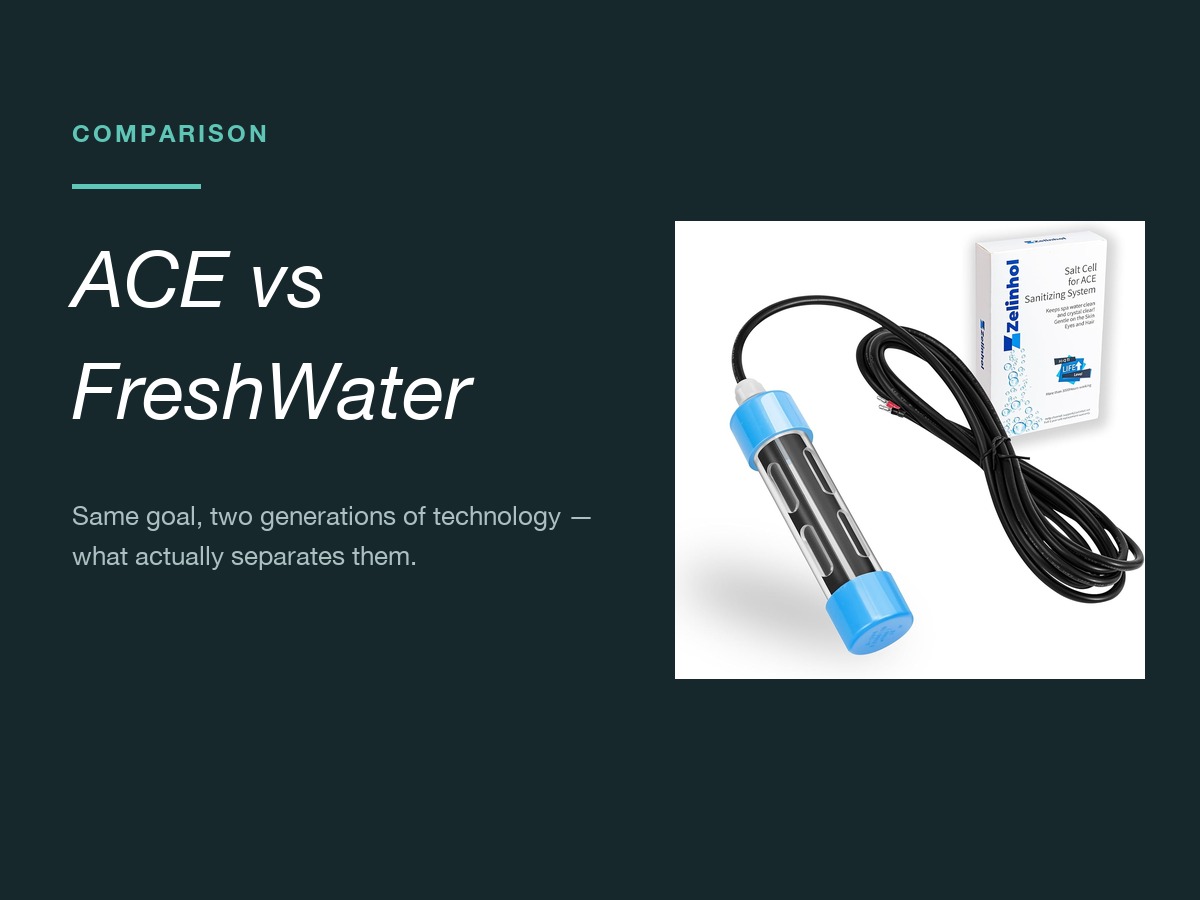
Watkins® — the company behind Hot Spring® spas — has sold two very different salt water systems over the years: the ACE® Salt Water System, factory-integrated on Highlife, Highlife NXT, and Limelight collections from roughly 2009–2021, and the newer FreshWater® Salt System, a cartridge-based design found on post-2019 collections. Both generate chlorine from salt. Beyond that shared principle, they differ in almost every way an owner actually feels: what you replace, how often, and what it costs per year. Here’s the honest comparison.
Both systems rely on electrolysis: a coated electrode converts dissolved salt into chlorine, and the chlorine reverts back to salt after sanitizing, making the process largely self-sustaining. If you want that chemistry in detail, see how a salt cell actually works. Where the two systems diverge is what happens to the electrode.
Same end product — chlorine made on demand from low-salinity water — but two completely different ownership experiences around it.
| Factor | ACE Salt Water System | FreshWater Salt System |
|---|---|---|
| Design | Cell-based, factory-integrated into the spa | Cartridge-based, built for quick swaps |
| Found on | Highlife, Highlife NXT, and Limelight collections, roughly 2009–2021 model years (optional equipment; pre-2019 in some markets) | Newer Hot Spring collections (post-2019) |
| What you replace | Cell (part 76078), typically every 2–3 years per official guidance | Salt cartridges, roughly every 4 months |
| Typical consumable cost (late 2026, market prices) | OEM cell sits in the high triple digits at dealers; aftermarket compatible cells sell at a small fraction of that | Cartridge costs recur roughly three times a year |
| Cell cleaning | Every 90 days, per the official maintenance routine | None — there is no cell cleaning ritual |
| Salinity feedback | Built-in salinity sensor with low-salt prompts | Lower-maintenance design overall |
ACE asks for a real calendar. The official routine is a weekly test strip, a 30-day check (confirm ACE settings, clean filters, test and balance, shock), and a 90-day cell cleaning. The system does help you — the built-in salinity sensor reports salt level, the panel lets you adjust output, and reminders prompt the 30-day routine. But the 90-day cell cleaning is genuine hands-on work, and skipping the 30-day routine has a consequence: the system defaults to a low-use output setting until you reset it.
FreshWater was engineered to lighten that load. There’s no cell to pull and soak, and the main recurring task is swapping the cartridge about every four months — a minutes-long job on a stick-of-butter-sized consumable. Neither system is zero maintenance; you still balance water, clean filters, and shock as needed in both cases. But on paper, the FreshWater rhythm is meaningfully lighter.
Back-of-envelope figures using market prices as of late 2026 — treat these as ballparks, not promises:
Both systems also share the small recurring stuff: salt top-ups, test strips, and occasional shock. To weigh either system against a traditional chlorine routine for your specific tub, our salt vs chlorine cost calculator does the arithmetic for you.
One caution on the ACE side: the 2–3 year figure is guidance, not a guarantee. Usage hours, output level, calcium hardness (the official target is around 50 ppm), filter cleanliness, and cleaning discipline all move the number. We break down what actually determines ACE salt cell lifespan in a dedicated article.
The two systems belong to different factory eras, and you can’t order one in place of the other on a new build. ACE was the optional salt system on Highlife, Highlife NXT, and Limelight collections across model years roughly 2009–2021 (pre-2019 in some markets), with a retrofit kit (76298) extending coverage to 2004–2008 Hot Spring tubs. FreshWater appears on newer post-2019 collections.
If you’re shopping used, the model year narrows it down fast: a 2014 Limelight is ACE territory, a post-2019 Highlife is FreshWater territory. When in doubt, a dealer can confirm from the serial number exactly what a specific tub carries. For the wider market picture — including third-party systems that work on any tub — see our roundup of the best salt water systems for hot tubs.
Your big-ticket consumable is the cell, and when it dies you have more than one way to deal with it: the OEM 76078 from a dealer, a verified compatible cell, or stepping out of the factory system entirely with a universal drop-in unit. The full decision framework — including when converting beats repairing — is in our article on whether to replace the ACE cell or convert to a salt system, and the mechanics of the swap are covered in the ACE replacement guide. If you already know you want the compatible-cell route, our ACE-compatible replacement salt cell is a verified option — check current pricing and availability on Amazon.
Your job is simpler but more frequent. Budget cartridges as a routine consumable — roughly three per year — and swap them on schedule rather than waiting for water to drift. There’s no cell to clean and no big-ticket part aging in the plumbing, but the recurring cartridge cost is a real, permanent line in your spa budget.
Not as a bolt-on, as far as we’re aware. The FreshWater system ships factory-fitted on newer collections, and we know of no official conversion path for retrofitting it onto an ACE-era tub. If the appeal is the lighter maintenance rhythm, the realistic options for an ACE owner are a compatible cell (a cheaper path to the same system you already have) or a universal drop-in system — both laid out in the decision framework linked above.
FreshWater is the newer, lower-effort design: cartridge swaps instead of cell cleanings, and a predictable, budgetable consumable pace. ACE is the older, more hands-on design with a more expensive factory consumable — but also a deep aftermarket that makes its running costs negotiable, and a factory integration many owners still prefer. Neither is a wrong answer; they’re answers to different questions asked a decade apart. What matters most is knowing which one your tub has, because the replacement habits — and the budget — follow from that.
No — they’re different mechanisms. ACE uses a long-service cell you clean every 90 days and replace every 2–3 years; FreshWater uses drop-in cartridges you replace about every four months and never clean. Both are Watkins salt systems, but they share little beyond the underlying electrolysis principle.
It depends on your ACE path. With OEM dealer cells, ACE runs several hundred dollars per year in consumables — typically more than FreshWater’s cartridges. With a compatible aftermarket cell, ACE’s annualized cost typically drops below FreshWater’s. All figures are ballparks from market prices, not promises.
Both are low-salinity systems — ACE targets 1,750 ppm, well below the roughly 3,000–4,000 ppm at which most people taste salt. Hot Spring sells its own spa salt (part 80000) for ACE; follow whatever salt guidance your system’s documentation specifies. For ACE owners, we cover salinity in depth in the ACE salt level guide.
Almost certainly ACE, if it has a salt system at all: ACE was the optional salt system on that era’s Highlife collection. A dealer can confirm from your serial number if you want certainty before ordering parts.
No — both make the same sanitizer the same way, chlorine generated from salt. Water quality in either system comes down to balancing, filtration, and staying on top of the maintenance routine, not the badge on the system.
When your ACE cell reaches end of life, a verified ACE-compatible replacement cell keeps the factory system running without dealer pricing. Check current pricing and availability on Amazon.