Address
304 North Cardinal
St. Dorchester Center, MA 02124
Work Hours
Monday to Friday: 7AM - 7PM
Weekend: 10AM - 5PM
Address
304 North Cardinal
St. Dorchester Center, MA 02124
Work Hours
Monday to Friday: 7AM - 7PM
Weekend: 10AM - 5PM
When the ACE cell on a Hot Spring spa dies, you have three realistic paths: the OEM 76078 cell, a verified compatible cell, or converting to a universal drop-in salt system. Here is how to choose between them.
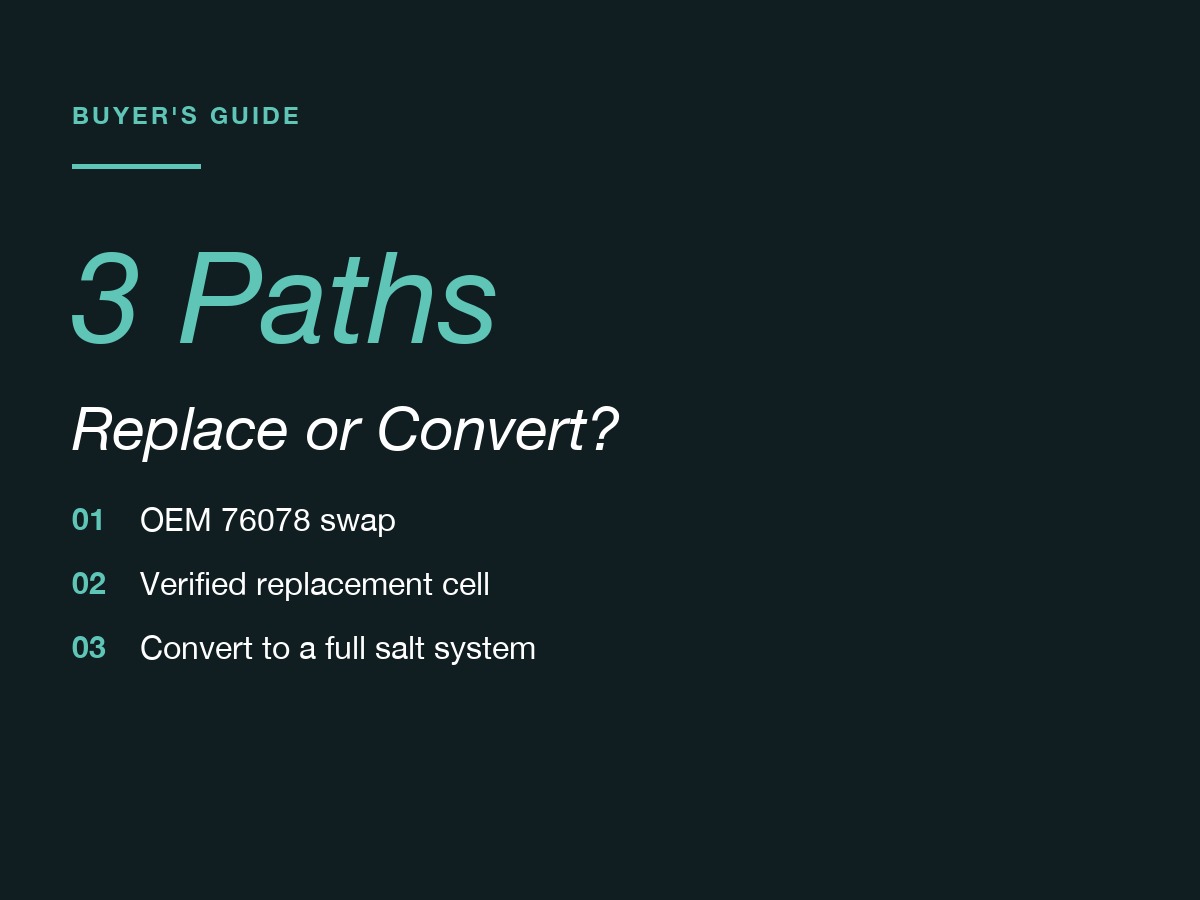
When the ACE® Salt Water System on a Hot Spring® spa stops making chlorine, the cell has almost always reached end of life — and Hot Spring’s own guidance puts that at every 2–3 years of normal use. From that moment you have three realistic paths: buy the OEM 76078 cell from a dealer, install a verified compatible cell, or step away from the factory system entirely and drop in a universal salt chlorinator. None of the three is universally “right.” The best choice depends on your tub’s age, how much life it has left, your budget, and how much you value the factory integration.
The cell is the wear item — Hot Spring’s official materials compare it to tires on a car — but other components fail too, and replacing a healthy cell fixes nothing. Before spending anything, work through the basics:
The full symptom checklist — chlorine output that stays low despite good salt, error messages, no improvement after a thorough cleaning — is covered in our ACE salt system replacement guide. If the cell is clean, the water is balanced, and the system still won’t hold sanitizer, it’s decision time.
| Path | What you buy | Typical outlay (late 2026, market prices) | Integration |
|---|---|---|---|
| A — OEM cell | Factory 76078 cell from a dealer | High triple digits at dealers | Full factory integration, dealer support |
| B — Compatible cell | Third-party cell built as a replacement for the 76078 | Aftermarket compatible cells commonly sell at a small fraction of the dealer price | Same connector and mounting position; runs inside the existing ACE system |
| C — Universal system | Standalone drop-in salt chlorinator | Varies by brand | Independent unit; not tied into the spa’s controller |
Here’s the honest version of each path, trade-offs included.
This is the factory replacement part, ordered through a Hot Spring dealer. You get an exact-fit part, the option of dealer installation, and zero compatibility questions. Dealer prices for the OEM 76078 cell sit firmly in the high triple digits as of late 2026.
Path A makes the most sense when:
The trade-off is equally simple. You’re paying the highest price on the board for the same core function — a coated electrode making chlorine from dissolved salt. If those dealer-network conveniences matter to you, that’s a legitimate reason to pay for them. If they don’t, Path A is hard to justify on economics alone.
Aftermarket cells built as replacements for the 76078 have been widely available for years, and on major marketplaces they commonly sell at a small fraction of the dealer price. A properly built compatible cell uses the same connector and mounting position as the original, so the spa’s ACE control panel keeps working the way it always has — output adjustments, salt readings, and maintenance reminders included. The installation is the same job the hub guide walks through for any replacement cell.
That price gap isn’t magic. It reflects the dealer distribution model behind the OEM part more than the cost of the electrode itself. What matters is vetting the seller: genuine reviews, a clear return policy, and support that answers if the cell misbehaves. We go deeper on what a good compatible cell must get right — connector and wiring fit, correct positioning to avoid low-flow errors, electrode material — in our guide to aftermarket ACE cell safety.
If your tub is otherwise healthy and you simply don’t want to pay dealer prices for a consumable that wears out every few years, this is the value path. Ours is an ACE-compatible replacement salt cell — check current pricing and availability on Amazon.
The third path stops repairing the factory system and changes the sanitizing strategy instead: a universal drop-in salt chlorinator that runs as an independent unit rather than through the spa’s control panel. One example is the MagicSpa universal drop-in salt chlorinator for tubs up to 2,500 gallons.
Honest framing: you give up the factory integration. Output is set on the unit itself, not the spa panel, and the built-in salinity sensor and reminder logic in the ACE system stop doing that work for you. You take over the monitoring the factory system used to handle. What you gain is independence from the ACE parts ecosystem entirely — no more 76078 cells, and no more worrying about the controller or power supply on aging factory electronics.
Conversion suits tubs where the cell may not be the only thing nearing retirement. If your spa is 10+ years old, the ACE system has already been through multiple cells, or you’ve had controller quirks on top of the dead cell, pouring more money into the factory pipeline gets harder to justify. The mechanics of switching over — what to do with the old system and how to get water chemistry right for the new unit — are covered step by step in our guide to converting a hot tub to a salt water system.
A tub you’ll keep for five more years justifies different spending than one you plan to replace next spring. A long horizon rewards keeping the factory system healthy — Path A if budget allows, Path B if it doesn’t. A short horizon favors the cheapest route to good water, or Path C if the whole electronics chain is suspect.
The cell is the wear item, but controllers (77401) and power supplies (74880) also fail on decade-old systems. If the repair conversation is creeping past a cell alone, the universal-system math improves. Our ACE parts explained article breaks down which part does what and what its failure looks like.
Compare the paths in cost-per-year terms rather than sticker price: an OEM dealer cell lasting its official 2–3 years, a compatible cell at a small fraction of that outlay, or a one-time conversion that removes the factory consumable treadmill. For the broader running-cost picture against traditional chlorine, our salt vs chlorine cost calculator runs the numbers for your tub.
Be honest about your own habits. Some owners never touch the output settings and ignore the 30-day reminders until the system nags them. Others genuinely use the panel integration every week. If you’re in the first group, the “loss” from converting is mostly theoretical. If you’re in the second, Path C will quietly annoy you forever — pick A or B.
Whichever path you pick, the water-care fundamentals don’t change: balanced water, clean filters, and a sanitizer level you actually verify with test strips. A new cell or a new system only works as well as the routine around it.
It can be — age alone isn’t the disqualifier. If the rest of the system is healthy and the cell simply wore out on schedule, a compatible cell keeps the factory system running for a fraction of dealer pricing. If the controller or power supply has also been flaky, that’s when a universal system starts winning the argument.
A cell built as a replacement for the 76078 is designed for the same connector and mounting position, so the panel interaction carries over. Verify your spa’s model and year before ordering — or use our ACE compatibility checker to confirm fit.
Generally yes — a drop-in system sanitizes independently of the factory plumbing controls. Follow the disabling and water-chemistry transition steps in our salt conversion guide so nothing downstream surprises you.
The symptom patterns differ. A worn cell typically means chlorine output that declines and doesn’t recover after cleaning, with otherwise normal system behavior. Power supply and controller faults tend to show up as error messages or a system that won’t run at all. Our ACE troubleshooting guide maps symptoms to parts.
Policies vary by dealer, and we won’t pretend otherwise. Some owners report perfectly normal service relationships with third-party cells installed; others prefer to keep everything factory-sourced while a tub is under warranty. Read your warranty terms and, if in doubt, ask your dealer directly before ordering.
If you’ve weighed the three paths and the compatible-cell route fits your tub and budget, our ACE-compatible salt cell is the fastest way back to hands-off water care. Check current pricing and availability on Amazon.