Address
304 North Cardinal
St. Dorchester Center, MA 02124
Work Hours
Monday to Friday: 7AM - 7PM
Weekend: 10AM - 5PM
Address
304 North Cardinal
St. Dorchester Center, MA 02124
Work Hours
Monday to Friday: 7AM - 7PM
Weekend: 10AM - 5PM
Softer water, less chlorine smell, and far less hands-on dosing. Here is how a salt water system works in a hot tub and exactly how to convert yours.
If you own a hot tub, you already know the routine: buy chlorine or bromine, test the water, dose it, shock it, and repeat. It works, but it is a chore — and the harsh chemical smell and irritated skin are part of the deal for a lot of owners. A salt water system changes that routine. Instead of you adding sanitizer by hand, the tub makes its own chlorine from ordinary salt, a little at a time, around the clock.
This guide walks through everything you need to decide whether a conversion makes sense for your tub and exactly how to do it. We cover why owners switch, how the technology actually works, which tubs can be converted, a full step-by-step process, how much salt to add, everyday maintenance, and the mistakes that trip up first-timers.
The appeal is not one big thing — it is a stack of small quality-of-life improvements that add up fast.
Softer, gentler water. A salt water hot tub holds a low, steady level of chlorine that is generated on demand. Because it is produced continuously in small amounts, the water tends to feel silkier and is far less likely to leave your skin dry or your eyes stinging after a long soak. Many owners describe the difference as “less pool, more spa.”
Far less chemical handling. You stop measuring and pouring liquid or tablet chlorine several times a week. The generator keeps the sanitizer level in range automatically, so the main thing you add is salt — and only occasionally.
More stable water. Manual dosing has a rhythm problem: you dose, the level spikes, it burns off, and you dose again. A salt system smooths that curve. The result is fewer algae scares and fewer “the water turned green overnight” emergencies.
Lower day-to-day cost. Chlorine and bromine are recurring purchases. Salt is cheap and you rarely need much. Over a season of regular use, the ongoing chemical bill drops noticeably.
None of this means salt water is “chlorine free.” It is chlorine — just made differently and held at a gentler, more consistent level. That distinction matters, and we will come back to it.
Helpful context: our Hot Tub Salt Water-Care Guide covers ongoing water care in detail once your system is running.
The core component is a salt chlorine generator. In a hot tub it is a small control unit plus a salt cell — a chamber containing metal plates (in quality units, titanium) through which the water passes.
Here is the chain of events:
A good generator lets you control how hard it works. The Zelinhol MagicSpa unit built for hot tubs and swim spas, for example, offers a 10-level output adjustment, so you can dial the chlorine production up during heavy use (a weekend of guests) and back down when the tub sits idle. An OLED display shows salt level, current output, and operating mode at a glance, which takes the guesswork out of tuning.
The target salt concentration in a hot tub is modest — compact systems such as the Zelinhol MagicSpa target 500–2,500 ppm (parts per million). That is well under one-tenth the salinity of the ocean and far below the point where water tastes or feels “salty.” It is a gentle concentration chosen so the cell can generate enough chlorine without stressing equipment or bathers.
Most acrylic, roto-molded, and inflatable hot tubs can be converted, because a salt system is added to the existing plumbing and circulation loop rather than replacing the tub itself. The practical checks are:
If you are unsure whether your specific make and model is a fit, our Salt System Compatibility Guide breaks down the details by tub type.
One note worth flagging: the market for dedicated hot tub salt systems has gotten thinner in recent years. Some well-known equipment brands have scaled back or discontinued their hot tub–specific salt lines, which has left a gap for owners who want a properly sized, purpose-built unit rather than a repurposed pool device. That supply shift is part of why purpose-built hot tub generators are worth seeking out.
Not all salt systems are created equal, and a unit sized for a 20,000-gallon pool is the wrong tool for a 400-gallon tub. When you are shopping for a hot tub–specific generator, a handful of features separate a good fit from a frustrating one.
Coverage matched to your tub. The single most important number is the maximum gallon rating. Oversizing slightly is fine and even sensible (more on that below), but a generator rated far above your tub’s volume is harder to tune down to a gentle level, while one rated too low will never keep up. For most hot tubs and many compact swim spas, a unit rated to about 2,500 gallons is the sweet spot.
Adjustable output. Water use is not constant. A quiet week and a long weekend with guests create very different sanitizer demands. A generator with multiple output levels — the Zelinhol unit offers ten — lets you match production to reality instead of running flat-out all the time.
Cell material. The cell is where the work happens, and its plates take the abuse. Titanium is the material to look for: it resists corrosion in the salty, warm, circulating environment of a hot tub far better than cheaper alternatives and is engineered for extended service life.
A real display. You cannot tune what you cannot see. An OLED or similar readout that shows salt level, output, and mode in one place turns water care from guesswork into a quick glance.
Self-cleaning and quick-change. Scale buildup is the enemy of any salt cell. A self-cleaning function reverses polarity to shed deposits automatically, and a quick-change cell means that when service is eventually needed, you handle it yourself in minutes rather than scheduling a technician.
These are the features that make the difference between a conversion you forget about and one that becomes a second chore. If a listing is vague about any of them, that is a signal to dig deeper before buying.
Before you start, read your generator’s manual end to end. The steps below are the general workflow; your specific unit may have small variations.
Step 1 — Confirm your water volume. Find your tub’s gallon capacity in the owner’s manual or manufacturer spec. If you cannot find it, use our Hot Tub Salt Calculator as a starting estimate, then verify with a measured fill if possible.
Step 2 — Balance the water first. A salt system works best when the baseline chemistry is already right. Get pH, total alkalinity, and calcium hardness into the recommended ranges for your tub before you install anything. If you are coming off a bromine system, it is often wise to drain and refill with fresh water so you are not fighting leftover sanitizer chemistry.
Step 3 — Install the generator and cell. Mount the control unit per the manual, then place the salt cell inline on the return line where water flows through it. Quality designs use a quick-change cell, meaning you can later swap the cell yourself without special tools or a service call. Plumbing is typically minimal and uses the fittings already in your equipment area.
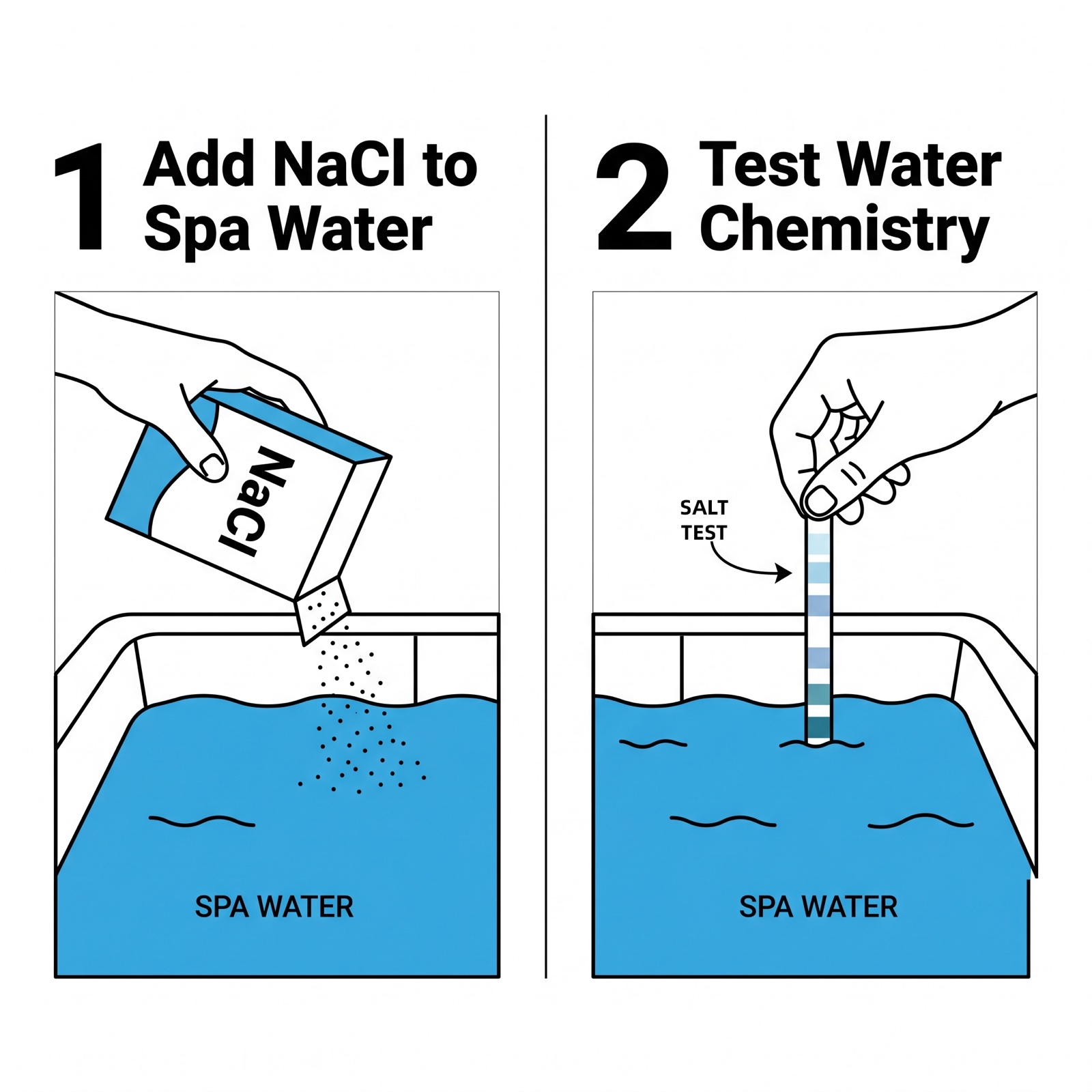
Step 4 — Add salt. With the pump running, add pool-grade salt gradually and let it circulate so it dissolves fully. Do not dump it all in one spot. (Exact amounts are in the next section.)
Step 5 — Power on and set output. Start at a mid output level and let the system run. Use the display to watch salt level and output. Adjust the level up or down over the next few days as you test the water.
Step 6 — Test and fine-tune. Test free chlorine and salt level after the first 24–48 hours of circulation. Nudge the output setting until your sanitizer holds steady in range without overproducing.
A printable version of this workflow, with the pre-install checks laid out in order, lives on our Installation Checklist.
This is the question every new owner asks, and the honest answer is: it depends on your tub’s volume and your starting salt level. Our Hot Tub Salt Calculator does the math for your exact numbers, but the logic is straightforward.
The calculator uses your water volume in US gallons, a target salt level in ppm, and (optionally) your current salt level and salt bag size. Internally it applies the density of water (about 8.34 lb per US gallon) to convert a parts-per-million target into a weight of salt. As the calculator itself notes, the result is a first estimate — you should add salt gradually, let it circulate, retest, and only then add more.
As a planning reference, reaching the top of that range (2,500 ppm) in fresh water works out to approximately:
| Tub volume (gallons) | Approx. salt to reach 2,500 ppm* |
|---|---|
| 250 | ~5 lb |
| 400 | ~8 lb |
| 500 | ~10 lb |
| 750 | ~16 lb |
| 1,000 | ~21 lb |
*Estimates derived from the calculator’s formula (volume × water density × target ppm). Your exact amount depends on starting salinity and the salt’s purity — always confirm with the live Hot Tub Salt Calculator and retest as you go.
For quick dosing, the MagicSpa guideline works out to about 2.5 cups of pool salt per 100 gallons of water — roughly 1.5 lb.
Use only the salt type and purity your generator’s manual specifies. Standard water-softener salt is usually not the right choice; look for a purity grade intended for salt chlorine generators.
A salt system removes the biggest chore — manual sanitizing — but it is not “set and forget.” A light routine keeps the water clear and the cell healthy.
When something looks off — cloudy water, low chlorine despite a running system, or a salt reading that will not climb — our Troubleshooting Guide maps symptoms to fixes.
No. Spa systems run at 500–2,500 ppm — well under one-tenth as salty as the ocean. You will not taste it, and the feel is silkier, not salty.
No, and that is by design. The system generates chlorine from salt. The difference from a traditional tub is that chlorine is produced steadily in small amounts rather than dumped in by hand.
Most standard hot tubs with a pump and filter can be converted. The key constraint is water volume — match the generator to your tub’s gallons. Verify specifics in our Compatibility Guide.
Far less often than you added chlorine. Salt is regenerated in the loop, so you mainly top up after refills, heavy splash-out, or drift below target. Use the calculator to estimate each top-up.
A well-built titanium cell is engineered for extended service life and a self-cleaning design reduces buildup. Eventually it will need cleaning or replacement, and a quick-change cell lets you handle that yourself. Exact timing depends on usage and water conditions, so monitor the display and follow the manual.
For most owners, yes. The switch trades a weekly chemical routine for a low, steady sanitizer level, gentler water, and a much smaller recurring chemical bill. The one-time work is modest: balance the water, mount the generator and cell, add salt, and tune the output.
If your tub is within the coverage range of a purpose-built unit, the upgrade is straightforward. The Zelinhol MagicSpa salt chlorine generator for hot tubs and swim spas is built for exactly this job — titanium salt cell, OLED readout, 10-level output, self-cleaning, and quick-change service — and covers up to 2,500 gallons.
Ready to see the unit and check fit? Visit the product page: Salt Chlorine Generator for Hot Tubs & Swim Spas (Up to 2500 Gallons). And before you buy, run your numbers through the Hot Tub Salt Calculator so you know exactly how much salt your tub needs.