Address
304 North Cardinal
St. Dorchester Center, MA 02124
Work Hours
Monday to Friday: 7AM - 7PM
Weekend: 10AM - 5PM
Address
304 North Cardinal
St. Dorchester Center, MA 02124
Work Hours
Monday to Friday: 7AM - 7PM
Weekend: 10AM - 5PM
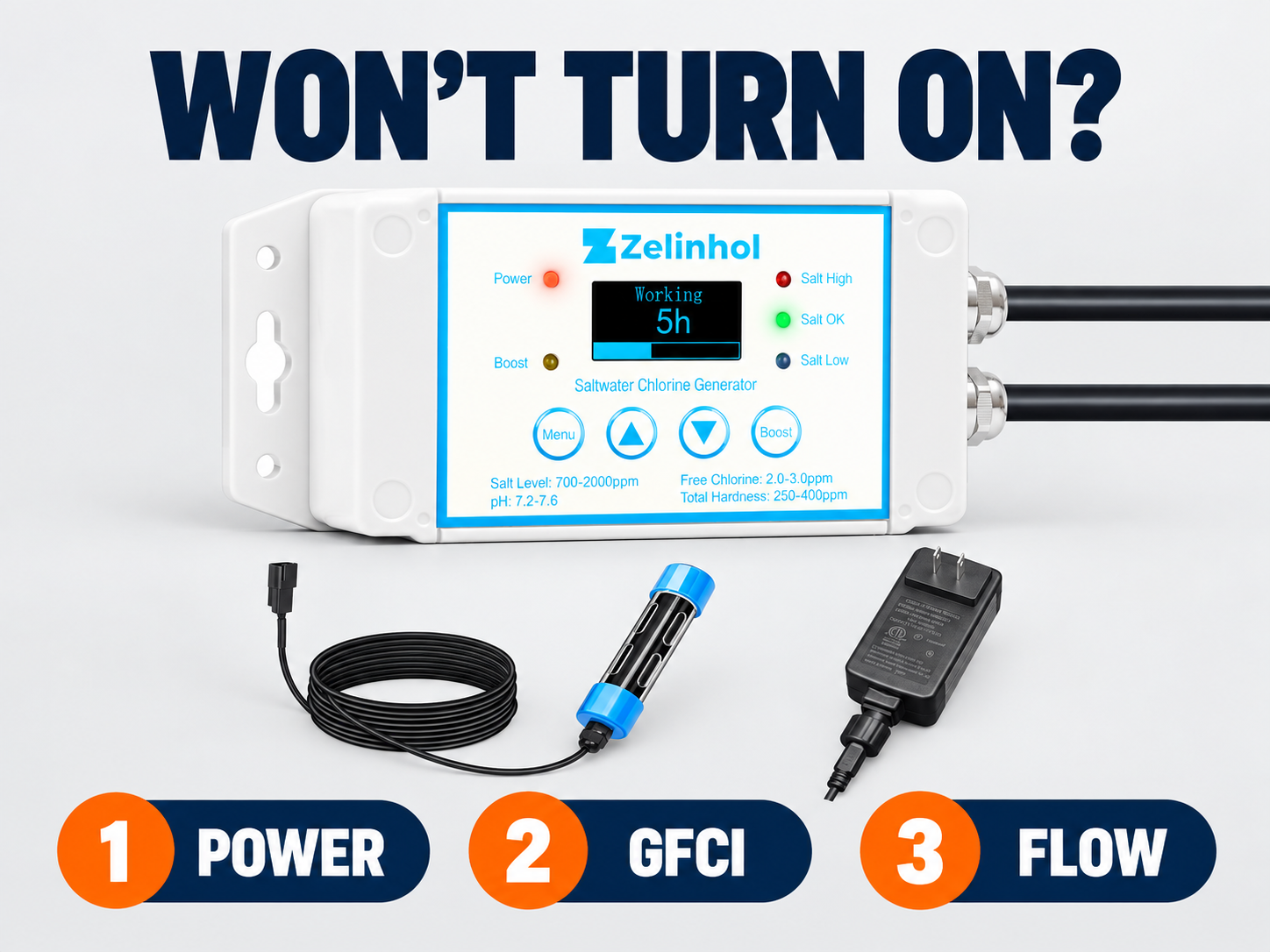
When a hot tub salt system won’t turn on, the instinct is to poke at the control panel until something lights up. Resist that. A salt generator sits right next to water and pump wiring, so the first rule is electrical safety, not quick fixes. This guide covers the safe, non-invasive checks you can do yourself – GFCI, outlet, power cord, and panel indicators – and draws a hard line at the point where you should stop and call someone qualified.
A unit that will not power on is different from one that powers on but makes no chlorine; if yours runs but underproduces, the hot tub salt system troubleshooting page is the better fit. This article is about “it is dead or won’t start.”
Most hot tub equipment runs through a GFCI (ground-fault circuit interrupter) for a reason: it cuts power the moment it senses a fault. A tripped GFCI is the most common “won’t turn on” cause.
If the GFCI is fine, step back to the supply.
With the unit powered off at the source, do a visual only.
If power reaches the unit, the panel tells you where things stand.
For the Zelinhol MagicSpa, the panel is part of a compact unit built for hot tubs and swim spas up to 2,500 gallons – the indicator behavior is documented in its manual, and that is the place to match a specific code to a cause.
Stop and get qualified help immediately if: you suspect any wiring, controller, or internal circuit problem; if the GFCI or breaker trips repeatedly; if you see burnt smells, melted fittings, or water at an electrical connection; or if the panel shows a fault you cannot clear by the manual’s safe steps. Never operate wet electrical connections, never bypass alarms or interlocks, and never open the control unit yourself. These are conditions for a professional, not a DIY fix.
Safe to do yourself:
– Reset a single GFCI trip and confirm the outlet has power.
– Visually inspect the cord for obvious damage with power off.
– Read the panel indicators against the manual.
Leave to a qualified technician:
– Repeated GFCI or breaker trips.
– Anything inside the control box or at the wiring.
– Water at an electrical point, burnt smells, or scorch marks.
– Fault codes the manual says require service.
My GFCI keeps tripping – is that normal?
A single trip can happen, but repeated tripping is a fault signal, not a nuisance. Stop resetting it and get it checked; clearing it over and over does not fix the underlying issue.
No lights on the panel at all – what does that mean?
Usually the problem is upstream: GFCI, breaker, outlet, or cord. Confirm those supply steps before assuming the generator failed.
Can I dry a wet connection and turn it back on?
No. If water is at an electrical connection, leave it off and get help. Operating wet electrical connections is unsafe and can damage the unit.
The panel lights but nothing runs – is it the cell?
Not necessarily. A lit panel means power is reaching the unit; a no-start from there can be an interlock or fault state. Match the indicator to the manual’s fault list rather than jumping to the cell.
When the unit does power on but still underperforms, the broader hot tub salt system troubleshooting guide and the hot tub salt system installation checklist help you confirm the setup was wired and balanced the way the equipment expects. For keeping the water in range afterward, the hot tub salt water care guide covers the routine, and the hot tub salt system compatibility guide explains whether your tub’s volume and plumbing match the unit.