Address
304 North Cardinal
St. Dorchester Center, MA 02124
Work Hours
Monday to Friday: 7AM - 7PM
Weekend: 10AM - 5PM
Address
304 North Cardinal
St. Dorchester Center, MA 02124
Work Hours
Monday to Friday: 7AM - 7PM
Weekend: 10AM - 5PM
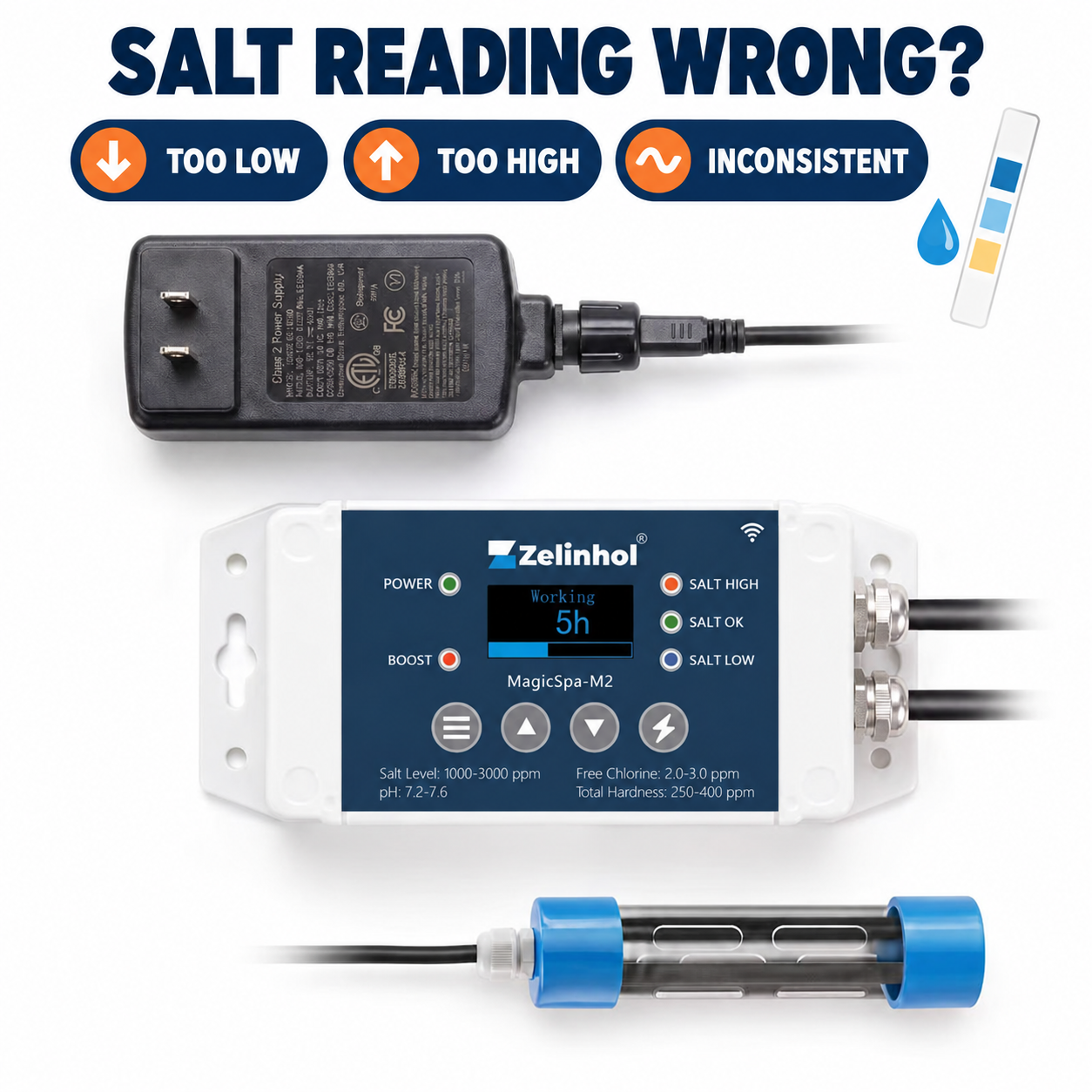
A hot tub salt reading that looks wrong is one of the most confusing problems because the number on your test strip, digital meter, or display may not match what the water is actually doing. Before you start dumping salt in or draining water out, it helps to separate “the reading is off” from “the salt really is off.” This guide covers the three common patterns – reading too low, too high, and inconsistent between tests – plus how to validate your test method, confirm your real water volume, and correct salt without overshooting.
We keep the product-specific numbers where they belong: in the manual. For the symptom overview, our hot tub salt system troubleshooting page ties this together with low chlorine, scaling, and cloudy water.
A low reading usually means one of three things: the salt really is low, the salt has not fully dissolved, or the test method under-reads.
If the salt is genuinely low, the fix is to add more – but measure it against your actual volume, not a guess. A practical starting point is about 2.5 cups of pool salt per 100 gallons (roughly 1.5 lb), then re-test after circulation. The hot tub salt calculator turns your tub’s gallons into a measured amount.
A high reading is harder to fix than a low one, because you cannot “add less salt” – you have to dilute.
When the same water reads differently across tests, the problem is usually the test, not the tub.
Validate the method first (next section) before you change anything in the water.
Different methods disagree, and knowing which one you trust matters.
When two methods disagree, trust the one you can repeat, and re-test after full circulation. If your unit shows a reading on its display, compare it to a manual test – a persistent gap can point to the sensor rather than the water.
Salt math breaks if your volume is wrong, and small tubs are unforgiving.
The MagicSpa is built for hot tubs and swim spas up to 2,500 gallons, so matching the salt dose to the true volume keeps you inside the working range instead of bouncing off the edges.
My strip says low salt but the display says normal – which is right?
Re-test both after a full pump cycle. If they still disagree, the manual test and the sensor may be sampling different water, or one method needs calibration. Validate the method before adding salt.
How do I lower salt without draining the whole tub?
Drain a portion and replace it with fresh water, then re-test. Small dilution steps are safer than one large drain, because you can always add salt back.
Can evaporation raise my salt reading?
Yes. Salt stays in the water when pure water leaves by splash or evaporation, so concentration climbs. A fresh-water top-off corrects it.
Does adding salt by the cup really matter in a small tub?
It matters more in a small tub than a pool. A few cups off-target moves ppm noticeably, so dose against measured volume and confirm with a second test.
For the companion numbers and step-by-step dosing, the hot tub salt calculator is the place to start, and the hot tub salt water care guide covers keeping those readings stable week to week.