Address
304 North Cardinal
St. Dorchester Center, MA 02124
Work Hours
Monday to Friday: 7AM - 7PM
Weekend: 10AM - 5PM
Address
304 North Cardinal
St. Dorchester Center, MA 02124
Work Hours
Monday to Friday: 7AM - 7PM
Weekend: 10AM - 5PM
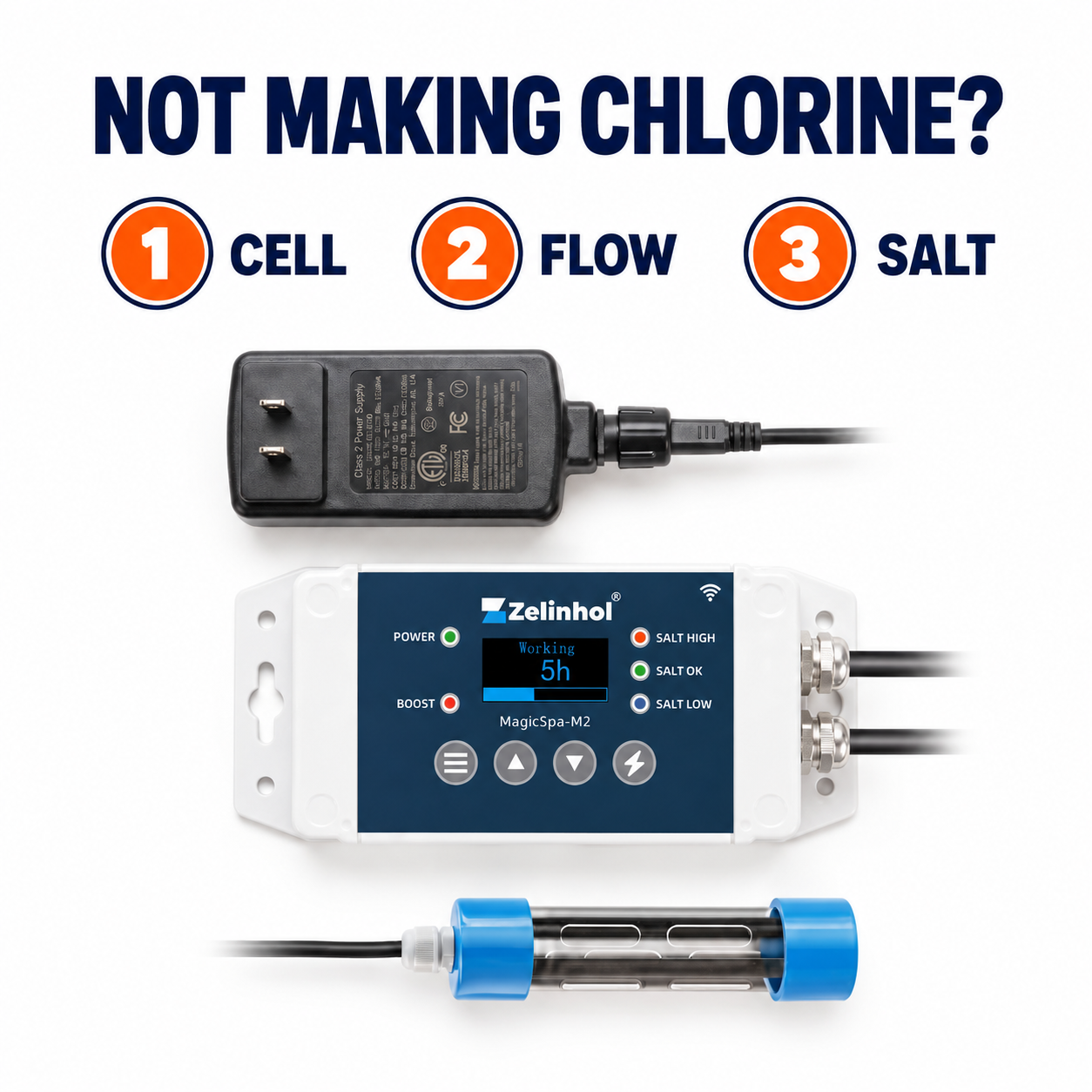
If your hot tub salt system is not making chlorine, the water can drift out of a safe sanitizer range within a day or two – and that is the kind of problem you want to catch before the water turns cloudy or green. A salt chlorine generator does not actually “store” chlorine. It produces a small amount continuously as water passes through the salt cell, so when production drops, the only chlorine in the water is what was already made. This guide walks through the exact order we recommend checking things, why each step matters, and the point at which you should stop and get help.
We cover the five checks in the sequence that the equipment itself depends on: salt level, pH and alkalinity, pump run time, the salt cell, and current water demand. Work top to bottom. Most “low chlorine” cases are solved in the first two steps, and checking them in the wrong order wastes time and salt. For the full symptom map, see our hot tub salt system troubleshooting overview.
The cell cannot make chlorine without enough dissolved salt, and it also struggles if there is too much. For a hot tub or swim spa setup such as the Zelinhol MagicSpa, the working range is 500 to 2,500 ppm. If your reading is below that, the generator may throttle or stop producing entirely.
Low salt is the single most common cause of “not making chlorine,” and it is also the least expensive issue to correct. Our hot tub salt calculator can help you translate your tub’s volume into a starting amount.
Even with perfect salt, the cell’s chlorine output is only useful if the water chemistry lets that chlorine work. High pH in particular suppresses the sanitizing power of the chlorine that is produced, so the test strip may show “some chlorine” while the water still is not protected.
Balancing is covered in our hot tub salt water care guide, which is worth bookmarking if you are tuning water weekly.
A salt cell only makes chlorine while water is flowing through it. If your filtration cycle is too short, the generator simply does not get enough operating hours to keep up with demand.
This is where a lot of “it stopped working” reports turn out to be a schedule change, not a failed part.
If salt and chemistry and run time all check out, the cell itself is the next suspect.
A heavily scaled or physically damaged cell will underproduce even when everything else is correct.
Finally, ask what the water is being asked to do. A fresh fill, a big soak with several bathers, or an algae start all raise how much chlorine the tub needs right now.
Stop and get professional help if: you suspect any electrical fault, controller failure, or internal wiring problem; if an alarm will not clear; if you see burnt smells, melted fittings, or water at an electrical connection; or if basic water checks pass but the unit still will not produce. Do not bypass alarms, operate wet electrical connections, or mix cleaning chemicals.
Why does my salt system read chlorine but the water still looks off?
The generator may be producing, but high pH or low alkalinity can blunt that chlorine’s effect. Rebalance the water and re-test after a full pump cycle before assuming the cell is at fault.
How fast should chlorine come back after I add salt?
Let the pump run long enough for the salt to fully dissolve and circulate, then re-test. Exact timing depends on your tub’s flow and volume, so follow the manual’s guidance rather than a fixed wait.
Can I just add chlorine tablets to fix low chlorine?
You can add sanitizer to protect the water short term, but that does not repair why the generator is not keeping up. Run the checks above so the system resumes doing the work.
My salt reading is fine but no chlorine – is the cell dead?
Not necessarily. pH, run time, and water demand explain many cases. Inspect the cell for scale and confirm the unit is actually powered and flowing before replacing anything.
If you have worked through these steps and still see low chlorine, the broader hot tub salt system troubleshooting page maps this symptom against salt-reading errors, scaling, and cloudy water so you can cross-check what you are seeing.