Address
304 North Cardinal
St. Dorchester Center, MA 02124
Work Hours
Monday to Friday: 7AM - 7PM
Weekend: 10AM - 5PM
Address
304 North Cardinal
St. Dorchester Center, MA 02124
Work Hours
Monday to Friday: 7AM - 7PM
Weekend: 10AM - 5PM
Is your Hot Spring ACE cell faulting or under-producing? This guide covers when to replace it, your replacement options, and how to install a compatible salt cell with confidence.
If you own a Hot Spring or Limelight spa with the ACE saltwater system, you already know the appeal: softer water, fewer jugs of chlorine, and a spa that largely sanitizes itself. But like every salt system, the ACE depends on a single wear item — the salt cell. When that cell stops performing, your clean-water automation stalls and you’re suddenly back to manual dosing.
This guide walks you through everything a Hot Spring owner needs to know about replacing an ACE salt cell: what the system actually is, the warning signs that point to replacement, your options (OEM versus a verified compatible cell), a pre-purchase checklist, and the basics of getting the new cell installed.
Internal reference: Before you buy anything, confirm your spa’s exact model and water capacity using our Hot Tub Salt System Compatibility Guide and our Salt Calculator.
The ACE Salt Water Sanitizing System is Hot Spring’s proprietary, factory-integrated salt chlorination system, available on most Hot Spring Highlife, Highlife NXT, and Limelight collections (model years vary by collection — most references fall in roughly the 2010–2021 range, so confirm your serial number with a dealer). Unlike add-on generators that hang in the water, the ACE is built into the spa’s plumbing and control architecture.
How it works is straightforward electrolysis:
Because the ACE is tied to the spa’s own controller, it offers a level of automation that bolt-on systems can’t match — when it’s healthy. When the cell degrades, the whole benefit collapses.
Replacing the cell is almost always far cheaper and faster than treating the symptom: buying chlorine by the jug, shocking the water, and fighting haze week after week. A healthy cell restores the hands-off water quality you bought the spa for in the first place, so it’s worth addressing the root cause rather than nursing a failing electrode along.
A salt cell doesn’t fail all at once. It loses efficiency gradually, then trips faults. Watch for these signals:
None of these alone is proof, but several together strongly suggest replacement rather than cleaning. For diagnosis steps tied to error codes, see our Salt System Troubleshooting guide.
When it’s time to replace, Hot Spring owners broadly have two paths.
The original equipment cell is the direct factory part. It’s designed to slot straight into your existing ACE assembly and is recognized immediately by the spa controller. For owners who want zero ambiguity and plan to keep a dealer relationship, this is the safe default. The trade-off is price: OEM ACE cells sit at a premium relative to the aftermarket.
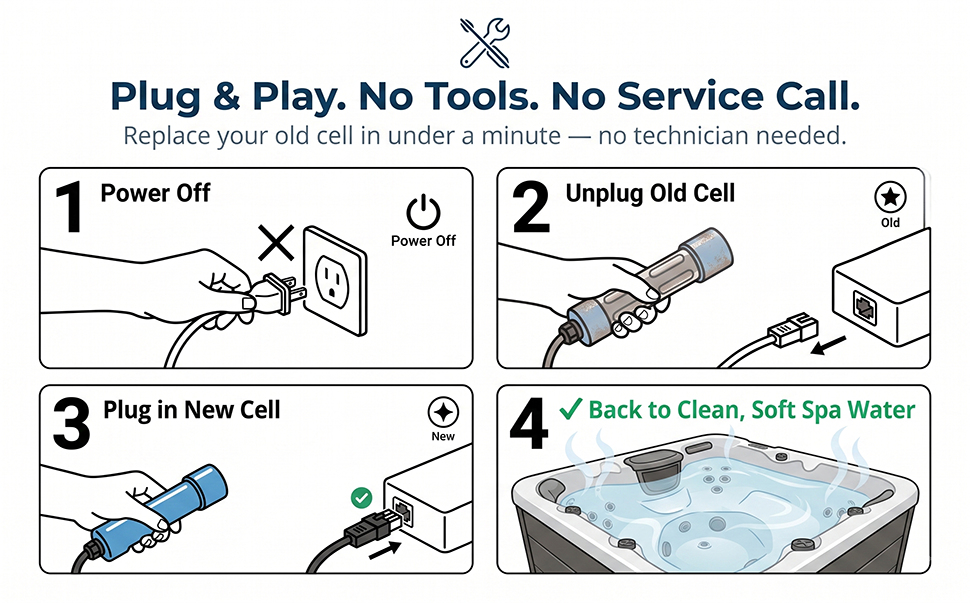
Several third-party manufacturers produce ACE-compatible replacement cells. One verified option is the Zelinhol 2025 Upgrade Salt Cell Replacement for the ACE Sanitizing System, which the manufacturer states is built for the ACE 76078 system and compatible with all ACE system-equipped Hot Spring spas. Per the product listing, it’s designed as a plug-and-play swap (“unplug–plug–unions”) that the spa’s ACE system recognizes on install, and it uses a transparent housing so you can visually monitor the electrode.
Because cells are not universal, the key word is verified. A compatible cell should explicitly name the ACE 76078 / Hot Spring fitment — not a generic “fits most spas” claim.
| Factor | OEM Hot Spring ACE (76078) | Verified compatible (e.g., Zelinhol ACE cell) |
|---|---|---|
| Fitment | Exact factory part | Built for ACE 76078; fits ACE-equipped Hot Spring/Limelight |
| Recognition by controller | Immediate | Designed for immediate recognition on install |
| Install | Plug-and-play unions | Plug-and-play unions |
| Price | Premium | Typically lower |
| Housing | Standard | Transparent (visual check) on some models |
| Support | Dealer network | Manufacturer after-sales support |
Understanding the mechanism helps you buy with confidence and maintain it well.
A salt cell is an electrolytic chamber. Inside are electrode plates (diamond-coated on OEM ACE, titanium-based on many aftermarket cells). When low-voltage current passes through salt water, chloride ions are converted at the electrode into chlorine. That chlorine does the sanitizing, then reverts to salt — so you’re not “consuming” salt, you’re cycling it.
Two features matter for longevity and convenience:
When you swap in a compatible cell, the spa’s controller treats it like the original: it reads the new electrode, resumes electrolysis, and continues automation. That’s the entire “magic” — there’s no recalibration step required on a properly matched part.
Before you spend a dollar, run through this checklist. It prevents the most common mistake in salt-cell replacement: buying the wrong part.
Note: Always verify the replacement part against your current model manual. Cells are not universal, and an incorrect match can damage fittings or fail to register with the controller.
Most ACE cell swaps are genuinely DIY. Owners routinely report installs measured in minutes, not hours.
What you’ll do:
When to call a pro: If your equipment panel lacks a free breaker slot, or if anything beyond the cell union looks suspect, a licensed electrician should handle it. For routine cell swaps, you typically don’t need one.
After install, rebalance and monitor water for the first week. Our Hot Tub Salt Water Care Guide covers ongoing salt-level and pH maintenance so your new cell lasts.
Start with a salinity test. If salt is in range and the cell still faults or under-produces after a cleaning cycle, the electrode is the likely culprit. A clean cell that won’t recover points to replacement.
A verified ACE 76078-compatible cell is designed to be recognized on install — owners report the spa’s ACE system identifies it immediately. Always confirm the listing explicitly states ACE / Hot Spring fitment before buying.
Yes, for the cell itself. It’s a union swap, not a plumbing job. Power down first, swap the unions, restore power. If electrical work beyond the cell is needed, use a licensed electrician.
Only if your salinity is low. Replacing the cell doesn’t consume salt; test first. The Salt Calculator helps you hit the right concentration.
Keep salinity and pH in the manufacturer’s ranges, run the self-cleaning cycle as designed, and visually check the electrode through a transparent housing if available. Avoid letting scale build between inspections.
This article is informational and based on publicly documented product specifications. Verify all fitment against your specific spa model and manual before purchase. Zelinhol sells a verified ACE 76078-compatible salt cell; confirm your model with support before ordering.